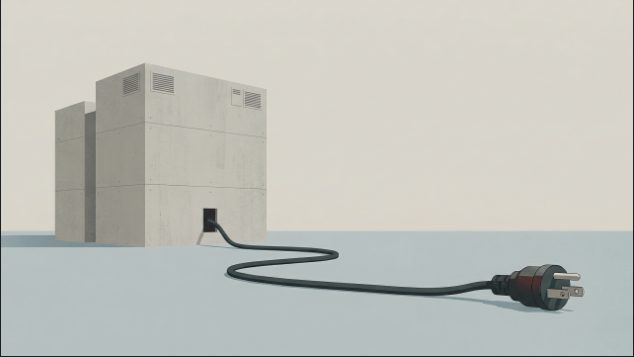
We Got Faster at Building Data Centers. We Didn't Get Faster at Turning Them On.
The industry industrialized construction and left integration to chance. Off-site partners are the lever but almost nobody is pulling it correctly.
A 60 MW data center loses roughly $14.2 million for every month it sits between "construction complete" and "revenue generating." That is $180/kW/month in lost lease revenue, plus standing-army costs for idle crews and vendors, plus contractual penalties that start accruing the day a handover deadline slips. Up to half of planned data centers faced delays in 2025. The industry has a schedule problem and it has spent five years optimizing the wrong part of the schedule...
Prefab modules. Factory-built cooling skids. Modular power systems craned into place in days instead of months. Construction has gotten dramatically faster. Microsoft's Mount Pleasant campus can get steel up at a pace unthinkable a decade ago and yet the facility won't process a single AI workload until late 2026 at the earliest, because the distance between "built" and "operational" doesn't shrink at the same rate. Commissioning hasn't gotten faster. It has gotten harder. And the industry didn't just miss that. It optimized away from it pouring capital and engineering talent into speed-to-erect while the process of proving a facility actually works remained manual, fragmented, and dependent on a workforce that is aging out.
The Problem Isn't Speed. It's Sequencing.
Commissioning a data center follows a rigid, gated process; five levels (L1 through L5) that progress from factory testing of individual components up to integrated systems testing where every power, cooling, fire, and controls system must prove it works together under normal, abnormal, and emergency conditions. Each level is a gate. You don't advance until you pass.
The traditional model assumed everything would be built on-site, in sequence, by the same trades, using the same documentation system, managed by the same general contractor. That worked when you were commissioning one building at a time.
It does not work when you are phasing a 100+ MW campus in 50 MW tranches, with a powered shell built by a GC, cooling skids shipped from a factory in Texas, power modules from a different factory in Ohio, control panels from a third vendor, and BMS integration handled by yet another subcontractor. Each has its own testing protocols, its own documentation format, its own definition of "factory tested and ready."
When they converge on-site for L5 integrated systems testing (the moment of truth) the commissioning team inherits a documentation patchwork and a set of systems that have never actually seen each other before. A VFD parameter sheet from the MCC vendor references one set of control points. The BMS integrator's script uses a different naming convention. The cooling skid's FAT report proves the skid works... but not that it works with this BMS, on this power bus, responding to these control sequences. Three weeks later, the culprit turns out to be a protocol mismatch that could have been caught in any of the three vendors' shops before a single module left the loading dock.
That interface is where projects bleed time. Not in the concrete pour. Not in the module set. In the space between "each piece works alone" and "the whole facility works as one."
Put differently: construction is now visible, scalable, and increasingly industrialized. Commissioning is still hidden, human-limited, and largely artisanal. We automated the first and left the second to chance.
The Workforce Math Doesn't Close
Even if the process were perfectly coordinated, the industry doesn't have enough people to run it.
You can train an electrician in months. You cannot fast-track a commissioning agent. L3 through L5 testing demands someone who can read a one-line diagram and a control narrative simultaneously and spot the discrepancy. Who knows what "correct" looks like when a utility transfer fires and the generator pickup initiates across multiple bus segments, who has watched enough chiller plants fail to recognize the fault before it cascades. That judgment takes years of facility-specific repetition to build. It does not compress into a certification course.
Only 15% of applicants for data center roles meet minimum qualifications. A third of the existing technical workforce is nearing retirement. Senior commissioning roles sit open for months. So projects finish construction and wait... sometimes competing for the same handful of qualified engineers with three other hyperscale builds in the same metro.
The building is done. The equipment is set. The twelve people who can prove it works are booked through next quarter.
Off-Site Partners Are the Underleveraged Lever
Prefab and modular construction has been discussed almost entirely as a construction play; faster builds, fewer field workers, controlled factory environments. All true. But the commissioning value of off-site work is being systematically under-exploited, because most off-site partners are delivering hardware, not commissioning-ready systems.
A cooling skid that ships with a packing slip and a basic functional test is a piece of equipment. It still needs full L3 and L4 testing on-site. Every control point verified, every VFD parameter tuned, every communication pathway proved. A cooling skid that ships with a complete Factory Acceptance Test package is something else entirely. What moves upstream: point-to-point wiring verification already documented, VFD parameters set and recorded against the owner's spec, control sequences validated against the actual BMS protocol the site will run, alarm responses pre-mapped and tested, all of it delivered in a format the CxA team can drop straight into their L3/L4 test scripts without translation.
That package turns three to four weeks of on-site work per system into days of confirmation. On a phased campus with four cooling zones, that is a month of schedule recovered before the L5 team even arrives. And yet most of the industry is not doing this which should tell you something about how the incentives are structured, not how difficult it is.
The same holds across the MEP stack. Control panels with pre-loaded PLC logic and pre-configured communications. MCCs with VFDs already tuned, fault thresholds set, harmonics characterized. Power distribution assemblies with relay coordination verified in the shop. Done right, each one converts what would have been on-site troubleshooting. Slow, expensive, dependent on scarce expertise... into on-site verification. The commissioning team stops discovering whether things work and starts confirming they still work after transport and installation. Faster. Cheaper. Less dependent on the twelve people everyone is fighting over.
Where It Keeps Breaking
So why isn't this standard practice?
Other industries figured it out. When Intel commissions a semiconductor fab, every equipment vendor ships against a validated systems protocol; Installation Qualification, Operational Qualification, Performance Qualification. With documentation structured to the owner's acceptance framework before the equipment leaves the factory. The handoff points between factory testing and site acceptance are defined, standardized, and auditable. A vendor that ships a tool with documentation in its own format and hopes the site team can translate it doesn't get a second purchase order. The pharmaceutical industry works the same way. These aren't bleeding-edge process innovations. They are decades old.
Data center construction hasn't built that discipline. The reason is partly cultural. The industry scaled so fast that process rigor trailed demand but mostly economic. Off-site vendors get paid for hardware delivery, not for commissioning outcomes. A panel shop that spends an extra 40 hours aligning its FAT package to the owner's Cx plan doesn't capture that value in the purchase order. So most don't bother. The cost shows up downstream; on-site, in the commissioning schedule, borne by the owner and the GC rather than the vendor who could have prevented it.
That misalignment produces the same three failures, project after project.
Factory test reports follow the manufacturer's format. Site commissioning follows ASHRAE Guideline 0 and the owner's L1–L5 matrix. The two don't map. The CxA team either re-tests what the factory already proved. Burning weeks of the scarcest labor in the industry or hand-translates between documentation systems. A factory that aligns its test reports to the owner's Cx plan from the start eliminates that translation tax entirely.
Controls and power assemblies ship without phased energization in mind. Modern data centers energize zone by zone, hall by hall. An MCC that controls cooling pumps for Zones A and B needs to run correctly when only Zone A is live. With graceful partial-plant logic, not an alarm cascade. That zone-awareness should be engineered in the shop and tested before shipment. Instead, it gets discovered during L3 when someone realizes the next zone isn't ready and the controls weren't designed for that reality. The field modification adds weeks.
And the integration layer — the controls, communications, and automation that tie individual systems into a coordinated facility — ships factory-assembled but not factory-proven. Building a BACnet/IP-enabled control panel is not the same as proving that panel talks correctly to the specific BMS platform the site will run. The distance between "protocol-compliant" and "integration-tested" is the distance between a clean L5 and three weeks hunting phantom communication faults across five vendors' equipment.
The Constraint Is Structural
None of this self-corrects when the build cycle cools.
AI workloads are pushing power densities past 50 kW per rack. Every increment of density adds cooling complexity, control sophistication, and interdependencies that have to be proved at L5. Campus-scale is the default now, which means phased commissioning is the permanent operating model. The workforce pipeline was never adequate and is now losing a third of its experienced base to retirement within the decade.
The question for every off-site construction partner — panel shops, MCC assemblers, skid builders, controls integrators — is whether they are selling equipment or selling time. The partners who ship systems that arrive on-site with documentation a CxA team can use, control logic that accounts for phased operations, and integration testing that holds up at L5 will own the critical path of every major build. They will price accordingly, because they are selling the thing the market cannot get enough of: weeks back on the schedule.
The partners still shipping hardware with a packing slip will compete on lead time and cost — against each other, at the bottom of a commodity market.
The constraint was never how fast you can build a data center. It is how fast you can prove it works. And right now, that answer is being shaped in panel shops and on factory floors, months before a commissioning agent ever sets foot on-site.
Litus Global Solutions #Commissioning #Prefab #IndustrialAI #Hyperscale #Automation #FutureofWork #AI #DataCenters #MissionCritical Schneider Electric Siemens Google Meta SpaceXAI