
The Market Is Still Counting Chips
Part 5 of "Counting Chips," and the last: how a components market became specified infrastructure, what that would mean for how these businesses are valued, and how to tell whether the market already knows
Early in my construction career, I learned that the most important sales call in a building's life happens in a room with no buyers in it.
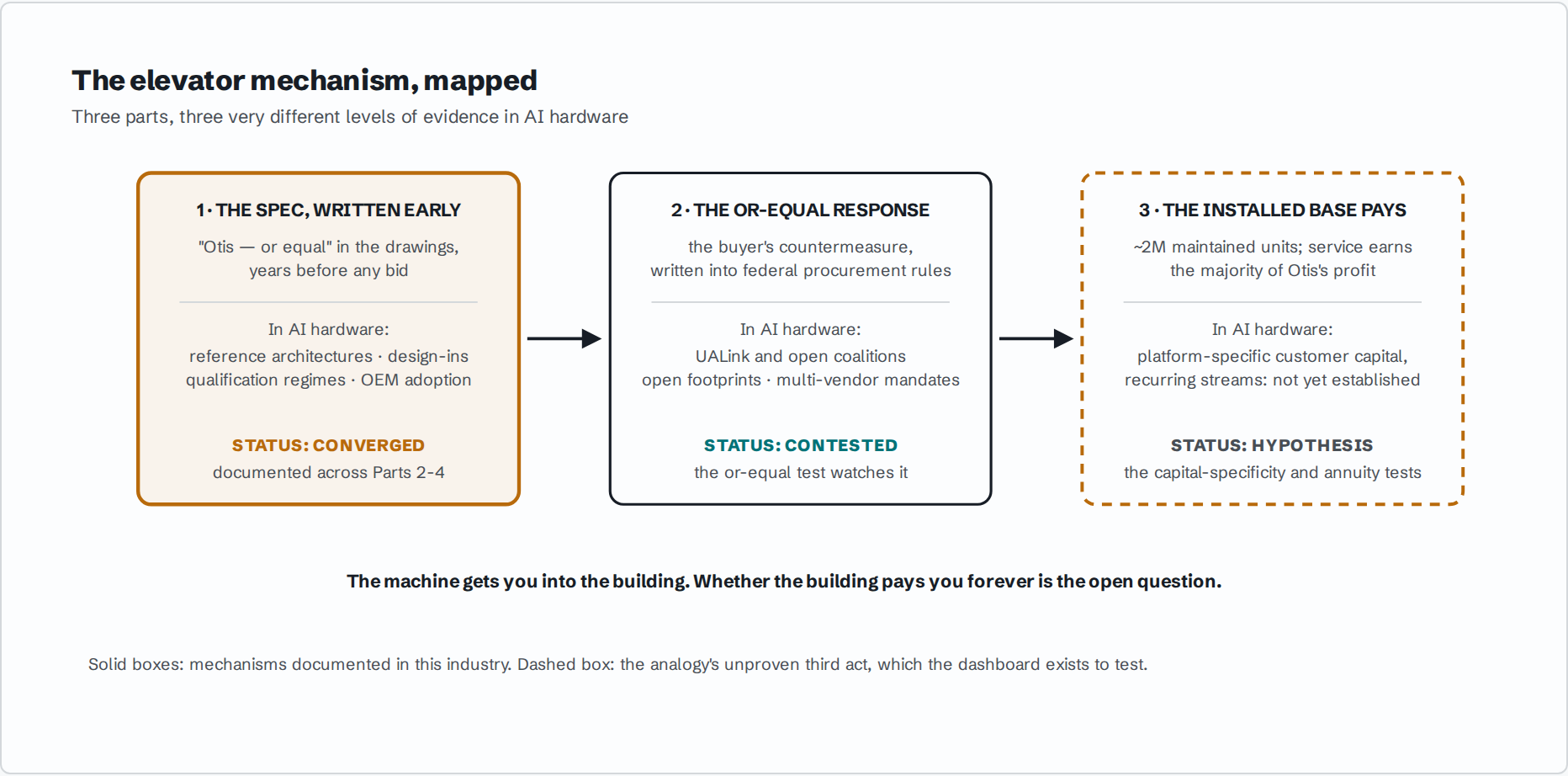
The room belongs to the design engineer. It is full of drawings, and somewhere in those drawings, years before a shovel touches dirt, someone writes a phrase like "Otis — or equal." That phrase looks harmless. It is the whole game. By the time the project goes to bid, every contractor pricing that building prices it around the elevator already named in the spec. A rival can win the job later theatrically. But it must prove itself "equal" to the incumbent's specifications, on the incumbent's terms. To an engineer who has no reason to spend risk on the swap. In my experience, it's an uphill road.
American procurement rules generally require by federal regulation a specification naming a brand allow an "or equal" alternative.¹ The countermeasure exists because a brand-specific spec, left unpoliced, narrows competition before any purchase order is written.
And here is the part that matters for the price of anything: look at how the elevator company actually makes its money. Otis, the name in all those specs, maintains roughly two million elevators and escalators worldwide, and that service business, not the machinery sale, contributes the majority of its profit.² A new elevator is sold once, at a competed price. The maintenance contract renews year after year, at service margins, with the incumbent holding the quiet advantage: the technician who already knows the building and the machine. And when the machine ages, the modernization contract arrives, a second harvest from the same shaft. The machine gets you into the building. The building pays you forever. For generations the company that worked this way was valued inside a conglomerate; its 2020 separation is a useful illustration, no more than that, of how differently the market can see a machinery seller and an installed-base annuity once they are visible separately.³
Hold that three-part mechanism in your head: the specification written early, the or-equal countermeasure, the installed base paying long after the sale. This series has spent four installments documenting the AI hardware industry converging on the first part, contesting the second, and, more speculatively, building toward the third. This final installment asks the question that follows: if the industry now sells the way specified infrastructure sells, what would that mean for how these businesses are valued, and how would we know whether the market has already figured it out?
The incomplete arithmetic
For anyone arriving here first, the series in four sentences:
The binding constraint in AI hardware rotates, from GPUs to memory and packaging to power and optics, so scarcity is a moving address, not a location (Part 1).
The unit of competition expanded from the component to the package: a bundle of rights determining who specifies, sources, qualifies, prices, and replaces each function (Part 2) (the part people seemed to like the most).
The most valuable position in the industry became the authority to author those boundaries and hold them steady while everything inside them changes on an annual clock (Part 3).
Demand now travels to suppliers through routes (captured, intermediated, contested) governed by a few coordinated blocs that all stand on one shared, constrained substrate (Part 4).
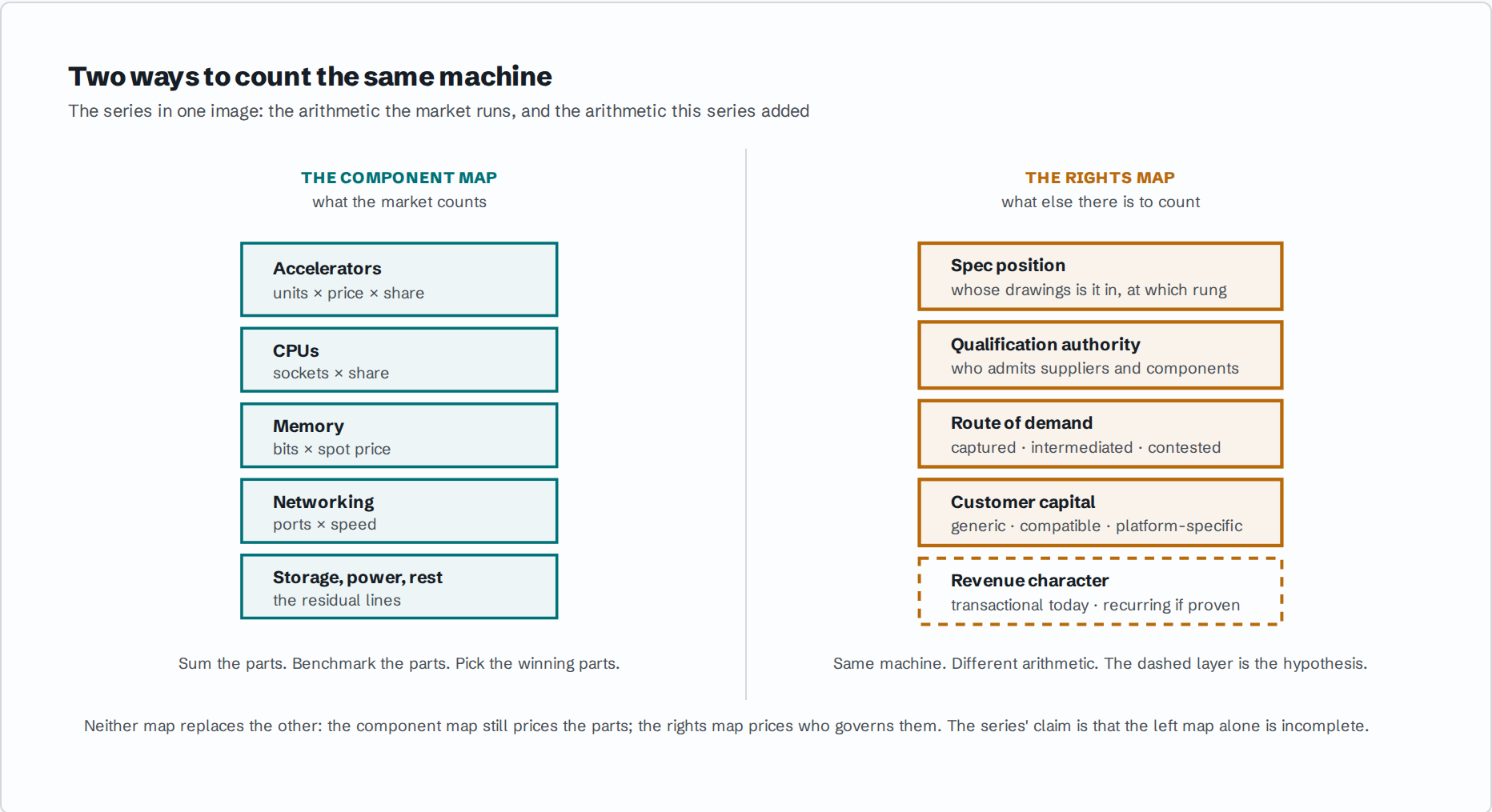
Each sentence describes a change in what kind of thing is being priced. A component market prices products: benchmark them, pick winners, multiply an addressable market by a share and a cycle. That competition hasn't disappeared; chips and memory and fabrics still get compared, fiercely. But the comparisons now happen inside system-level evaluations, which is a different thing to price. The route demand travels decides who gets to compete and on what terms; the destination still decides the revenue. Component arithmetic sees only the destination. So the claim here is not that the old arithmetic is wrong. It's incomplete, and whatever valuation errors exist would live in the part it doesn't cover.
What does the market count today? Read a sell-side initiation, or sit through a quarter's earnings Q&A: data-center revenue growth, accelerator units, average selling prices, share shifts, ramp timing, supply, margins. What rarely appears: qualification breadth, spec position, platform-specific customer capital, or any attempt to separate recurring revenue from the cycle.⁴ That's an observation of practice, not a survey. But it's what the title refers to, and what the rest of this essay tries to make testable (hopefully).
From market share to spec share
Start with the concept the fuller arithmetic runs on. In construction, the position that matters is called the basis of design: the named product the engineer drew the building around. The share that predicts the future is not the share of last year's purchase orders. It is the share of this year's drawings.
But construction also teaches a distinction the AI conversation blurs constantly. A manufacturer's design guide is not the engineer's basis of design. A vendor can publish beautiful reference architectures all day; what matters is whether they show up in the customer's forward plans. A spec analysis that counts vendor publications is counting brochures.
So what counts as real evidence? Three kinds, answering three different questions. Is anyone actually building on it: an OEM designing products around the architecture, a customer qualifying it into production, a tender naming it. How close is it to money: capacity committed, under construction, deployed. And does it last: the position surviving into the next generation. The kinds don't stack into one number, the order varies case by case, and durability is its own dimension: surviving a generation proves staying power, not a new win.
By that standard, Nvidia holds real positions. OEM adoption of its rack architecture is broad and documented. Facility-level adoption of its reference designs is a mix of announced projects and analyst inference. Its qualification regimes govern admission to its own platform's fleets, which proves platform governance, not customer adoption.⁵ Nvidia also publishes a large pile of design ambition that is not yet anyone's basis of design, and that pile never gets added to the first. Even its contribution of rack specs to open standards cuts both ways: a footprint everyone builds to spreads the platform and lowers the cost of swapping what sits inside it.⁶ Which effect wins is a question the series already assigned to a test.
One confession before the concept runs away: "share" needs a denominator, and nobody has one yet. Share of what? Planned megawatts? Rack capacity? Tenders? Qualified configurations? Each measures something different, and none is cleanly observable today. For the sake of argument we'll call it spec position and save spec share for when it has a defined denominator. A lens for now.
What does the lens add to the design-win analysis investors already do? The unit and the span. A design win prices a component into someone else's system. A spec position measures authority over the system itself: the interfaces, the qualification regime, the admission of everyone else's components. That's the level where the industry now competes. And it leads by years: a custom accelerator runs two to three years from engagement to deployment, facilities longer, so this year's design-ins are 2028's revenue tables. But lead time is probability, not certainty. A spec position is a probability-weighted forward position. Calling it backlog would turn evidence into enthusiasm. Same discipline afterward: a won qualification makes a supplier eligible and advantaged next round, not incumbent by right; customers routinely qualify several. Qualified, awarded, shipping, and persisting are four different states.
The buyers, for their part, have reinvented the or-equal clause. That's the most useful way to read the UALink consortium: an organized attempt by major customers (with suppliers at the table too) to convert "NVLink" in the industry's forward designs into "NVLink, or equal."⁷ A standard is not a purchase document, and its existence guarantees nothing about adoption. But spec capture is beatable, and the countermeasure industry is funded.
One historical objection deserves its answer here, because the sharpest readers of this series raised it. Integrated, spec-driven computing has existed before: Cray built extraordinary machines for decades, custom silicon included, and lost anyway. Commodity microprocessors overwhelmed the custom-silicon business thoroughly enough that the era has a name, "the attack of the killer micros." Volume economics wasn't the only cause, but it was the decisive one.⁸
Why would this time differ? Because the scale that once belonged to the attackers now belongs to the integrated players, in two forms. Nvidia's is merchant: accelerators in the millions plus the industry's largest developer ecosystem. The hyperscalers' is captive: custom-silicon volumes Cray never approached, plus ownership of the workloads, which means the buyer writes its own spec. Cray had neither. Integration without volume, hundreds of systems, and no component market ever reorganized itself around Cray's choices.
And the Cray precedent is not defeated; it is the warning label. Open fabrics and standardized racks are an attempt to run the killer-micros play again, one system layer up. Whether it works is Part 4's coalition test, not a settled fact.
The two-speed company
Now the valuation question the series has been building toward. Part 3 found Nvidia's strategy in one sentence: stabilize the boundary, accelerate what changes inside it. Read that with an investor's eyes and it describes two different economic characters sharing one income statement.
What can you actually see? The revenue: hardware sales, attach content sold with new systems, repeat purchases. The structure: a platform whose boundary holds still, generation after generation, while everything inside it changes. What can't you see, from any filing: a separate recurring stream, or revenue that would survive a customer skipping a generation. So two-speed is a hypothesis about economic character, not a claim that two businesses already exist; the boundary may create switching costs and forward demand without ever becoming a recurring business.
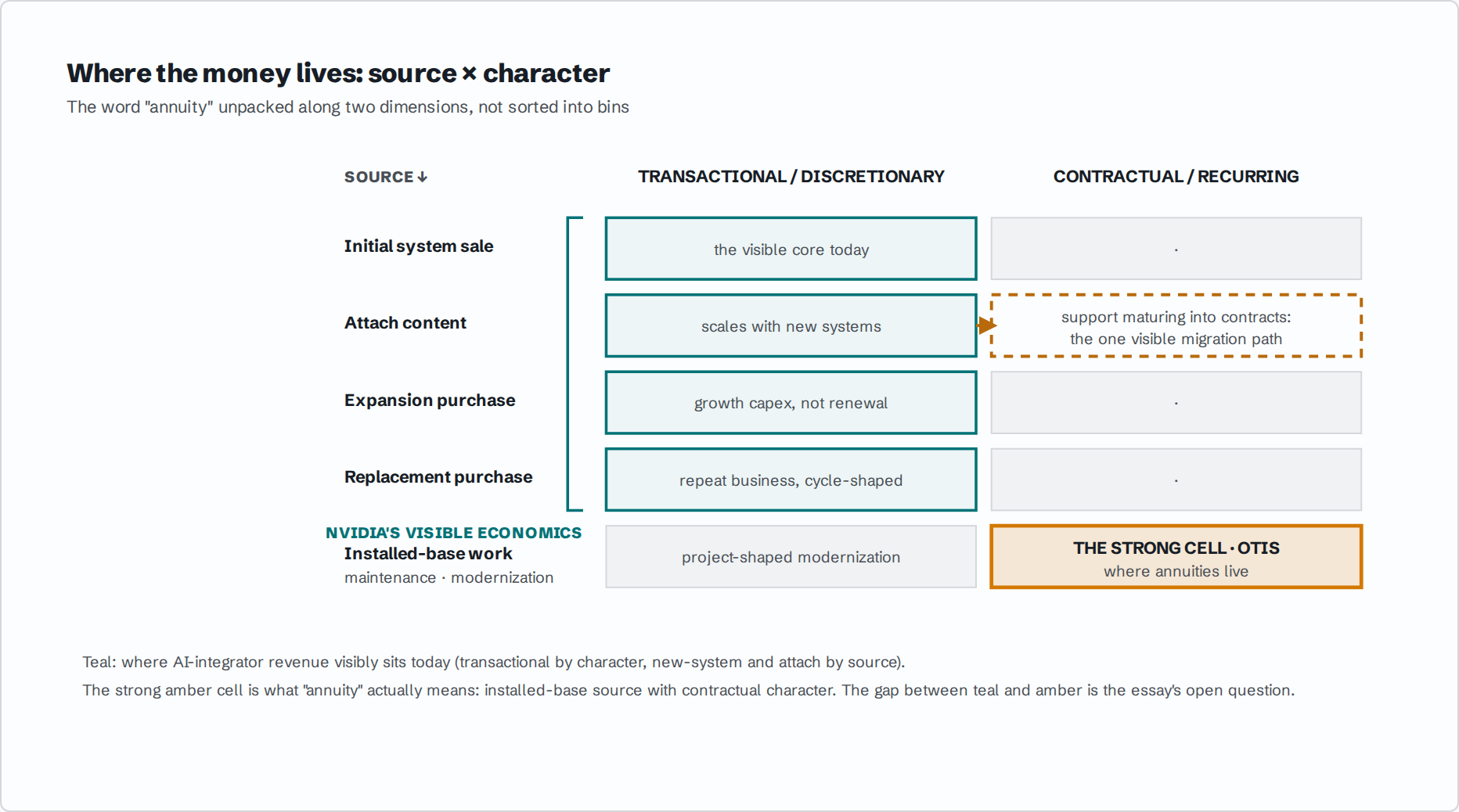
To price the hypothesis, take apart the word "annuity." Every dollar of revenue has a source: a new system, content attached to it, an expansion, a replacement, or work on machines already installed. And every dollar has a character: contractual, or discretionary. The two cross. Otis's maintenance contracts are installed-base work with contractual character: both strong dimensions at once, which is exactly what an annuity is. An expansion order from a growing customer looks like loyalty but is growth capex. Attach content is reliable, and still transactional. And support that begins as attach can mature into contracts, which is the one visible path by which a hardware seller's revenue changes character.
Put Nvidia's visible economics on that grid and the gap to Otis states itself: overwhelmingly new-system and attach by source, transactional by character, with contractual recurrence present (software, support, licensing) but not separately established in disclosure, and installed-base work little visible.⁹ The stabilized boundary could mature toward the strong cell; the footprint continuity, the qualification regimes, and the customer capital are the preconditions. But "annuity" is presently a hypothesis about direction, not a description of reported revenue.
Whether it matures depends on what "customer capital" actually means, because the phrase hides three very different things. Some of it is generic: a powered shell that can host any platform, which is durable and helps rivals, because a reusable building lowers the cost of switching tenants. Some is platform-compatible: built to a footprint, cheaper to keep than to change, but changeable. And some is genuinely platform-specific: software ported to one environment, fleets qualified to one regime, operating processes built around one architecture. Capital that would have to be rebuilt to leave. Only that last kind creates Otis-grade lock-in, and software and qualification may bind tighter than anything physical. The chain matters: a spec can win the first purchase; qualification can control admission; platform-specific capital can create persistence; and persistent revenue still has to show up before anyone says annuity. Each link is weaker than the last, which is why the third link gets its own test below.
The valuation problem that remains is real even at hypothesis strength, and it's about observability, not proven market error. Investors run sum-of-the-parts logic on undivided companies all the time. The problem is that current disclosure makes the two speeds nearly impossible to separate from outside: product-cycle revenue dominates every reported line, attach and recurring streams fold into segment totals, and the durable layer's cash-flow character can only be guessed. The market may be pricing the blend correctly, incorrectly, or not at all; nobody outside can tell, and that inability is the finding.
The elevator industry once had exactly this problem. Otis's service annuity spent decades folded inside United Technologies' conglomerate accounts, one durable business blended invisibly into many cyclical ones. When Otis finally traded on its own in 2020, the annuity became a line item anyone could put a multiple on. Separation was one way of making two speeds visible. Disclosure is another, which is why the dashboard below watches for it.
"Infrastructure," meanwhile, should carry no automatic multiple in either direction: recurring software-like revenue commands premiums, regulated utilities trade at discounts, and the same word covers both. The word does no valuation work. The revenue decomposition does.
So define the term this essay's title hangs on. A specified-infrastructure business is one where competition is substantially decided at specification time; where the product anchors durable customer capital around itself; and where admission of suppliers and components into the resulting installed base is gated by qualification. By that definition: the structure is real. The lock-in is testable. The economics are unproven. The pricing is unresolved. Every claim in this essay lives at one of those four levels.
The candidate pricing errors
If component arithmetic is incomplete, the gap should produce recognizable kinds of pricing error — candidates, because the tests decide whether they exist. Five, ordered by what this installment contributes, with the series' own examples as illustrations rather than recommendations.
Spec position priced as absent revenue. The design-in lag means a company stacking real spec wins can look unremarkable in its current numbers, and unit arithmetic reads that as no business there. The question: does the price weight the company's position in customers' forward designs at all? You can't answer it from price alone; it takes analyst models or repeated market reactions that visibly respond to qualification and adoption news.
Two-speed companies priced as one blend. A durable boundary and a fast-obsolescing interior reported as one stream get priced as all product cycle, or all platform-forever, and both readings ignore half the company. The question: how much revenue would persist through a generation lost on benchmarks? Treat the answer as a durability probe, not proof of an annuity: revenue can persist through supply, software friction, or simple availability. And nobody outside the company can currently compute it, which is the observability finding again.
Substrate priced as bloc-locked. Bloc drama invites winner-risk discounts on streams whose qualification breadth spans the combatants. Broad qualification reduces winner risk; it doesn't make architecture irrelevant, since bloc mix still moves die sizes, packaging intensity, memory content, and allocation. The question: does this stream's value depend on who wins, or mainly on whether the aggregate build continues?
Bloc-locked priced as substrate. The mirror image, and the most immediately useful category in the family. A stream qualified into a single stack produces smooth revenue between refreshes that looks diversified in the financials, while the alliance layer stays invisible until a socket is lost, at which point, as Part 2 put it, you lose a generation, not a quarter. The question: if this bloc's next architecture dropped the stream, what fraction of the growth story survives?
The diplomat, unpriced in both directions. Four things look identical from outside: ordinary multi-client design work, bloc-specific co-design, genuine cross-bloc interoperability products, and financing relationships. Only the third is diplomat revenue, and Part 4 left it a hypothesis with a test attached. For the candidate names the series has discussed (Marvell, Broadcom), the question is Part 4's, verbatim: franchise, or service?
Why the market might be right
An essay proposing a fuller arithmetic owes the old one its best defense, and there are five.
First, the efficient answer: prices may already contain all of it. Nvidia trades at a premium to historical semiconductor multiples;¹⁰ perhaps that premium is the platform, the spec position, and the optionality, fully priced, and the incompleteness lives only in commentary. The tests below probe this; they don't presume its failure.
Second, and this is the defense the opening analogy most needs to face: AI hardware may simply not have Otis economics. The asset lives are years, not decades. Obsolescence is engineered annually, on purpose. There is little mandatory service revenue visible in disclosure. The customers are the most technically sophisticated buyers on earth, actively building alternatives. And the facility outlives the compute inside it, which makes the building the durable asset and the racks the consumable. The response is partial by construction: the annuity hypothesis was never about the machine. It rests on the platform-specific slice of customer capital (software, qualification, operating process) surviving each generation of silicon. Real mechanism, unproven, which is why it has its own test. If the platform-specific capital proves shallow, the elevator was a story about elevators.
Third, specification regimes unwind. The or-equal clause exists because spec capture is beatable; IBM's administered world unbundled; UALink is funded by the customers with the most power to challenge architectural authority. A world where the countermeasures succeed is a world where spec-driven pricing power, wherever it exists, deflates.
Fourth, reclassification could run downhill. If the market does adopt an infrastructure frame, nothing guarantees the repricing is upward: durable, slower-growing characteristics can command lower multiples than product-cycle hypergrowth. Being right about the category and wrong about the direction is a real way to lose money.
And fifth, the convoy, one last time. Every layer of every map this series has drawn is financed by the same wager: that today's capital expenditure becomes tomorrow's AI revenue. That wager is senior to every claim in this essay. If it fails broadly, the category question becomes a footnote to a much simpler story.
The standing dashboard
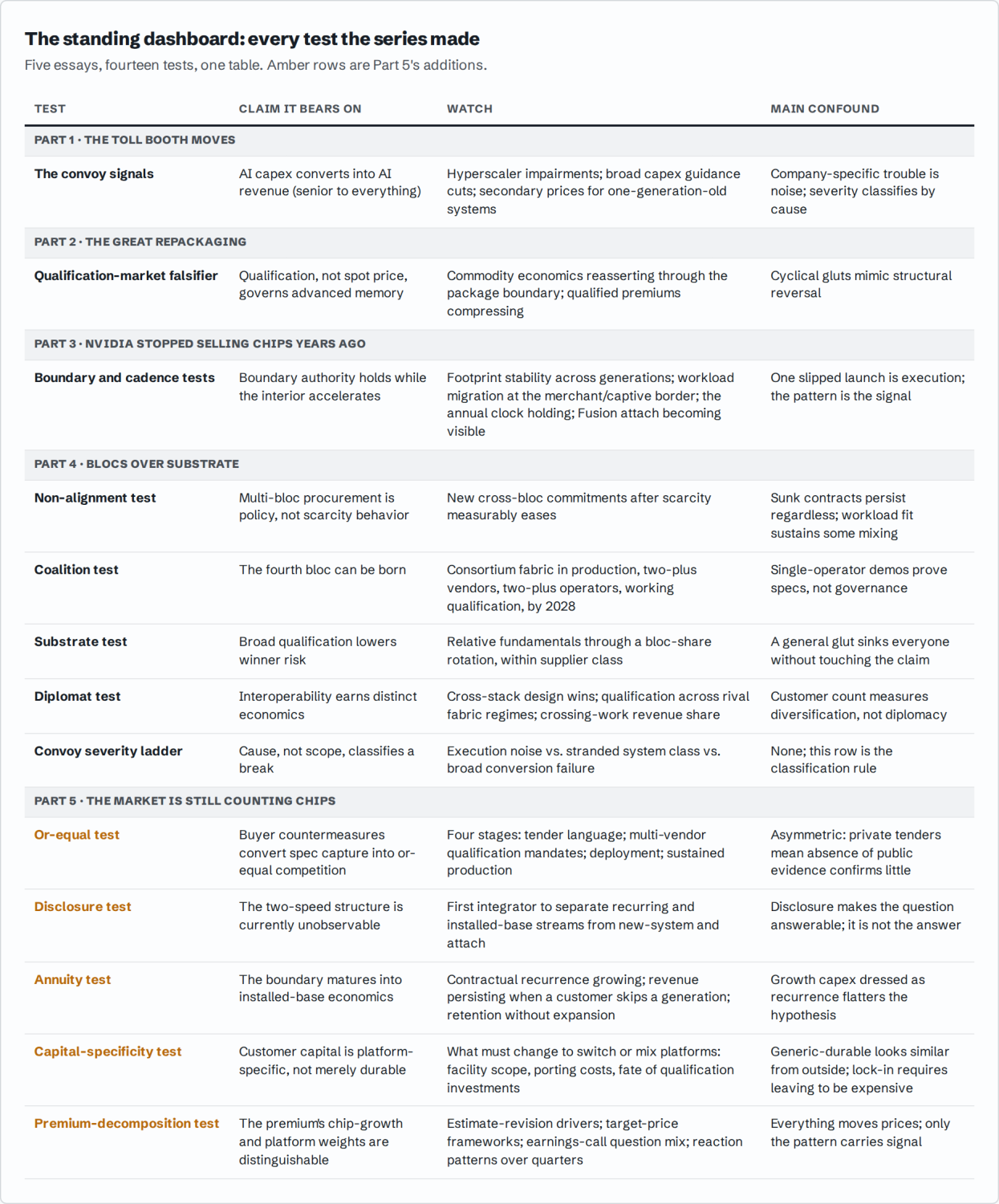
A series that promised falsifiers should end with them in one place. The inherited set, one line each. Part 1: the convoy signals (hyperscaler impairments, broad capex cuts, secondary prices breaking for one-generation-old systems). Part 2: commodity memory economics reasserting through the package boundary. Part 3: footprint stability, workload migration at the merchant/captive border, the annual clock holding, Fusion attach becoming visible. Part 4: non-alignment surviving abundance; the coalition reaching production governance; substrate resilience through a share rotation; diplomat evidence resolving franchise or service; the convoy severity ladder. The full statements live in their installments, and the complete set appears as a single table in this essay's figures. The five tests this installment adds:
The or-equal test. If buyers are converting spec capture into open competition, it shows up in four stages: open-standard language in tenders, then multi-vendor qualification mandates, then actual deployment, then sustained production. Watch them separately: language spreads faster than adoption. And the test is asymmetric: tenders are mostly private, so open requirements appearing means something; public silence proves little.
The disclosure test. The two-speed structure is unobservable until someone reports it. Watch for the first integrator to separate recurring and installed-base streams from new-system and attach revenue. Some streams can already be partially inferred (refresh through customer commentary, attach through content-per-system analysis); the true gap is contractual recurrence and installed-base work. Disclosure makes the question answerable; it isn't the answer.
The annuity test. Does the stabilized boundary actually mature into installed-base economics? The evidence that counts: contractually recurring revenue growing as a share of totals, revenue persisting when a customer skips a generation, retention independent of expansion. The trap: growth capex from an expanding customer dressed up as recurrence. Any test that can't tell the difference will flatter the hypothesis.
The capital-specificity test. The bridge test of the installment: is the capital customers build around platforms actually platform-specific, or just durable? Watch what must change when an operator switches or mixes platforms: facility modification scope, software porting costs where disclosed, the fate of qualification investments, whether shells built to open footprints host successive platforms cheaply. A long-lived facility is evidence of lock-in only if leaving it is demonstrably expensive for the customer. The essay's chain holds or breaks here.
The premium-decomposition test. Chip-growth premium and platform premium can coexist, so the test reads their relative weight. Watch the proxies, not raw price moves: which variables analyst estimate revisions cite, whether target-price frameworks start referencing qualification breadth or recurring streams, the mix of earnings-call questions, and reaction patterns across events over quarters. Everything moves prices; only the pattern carries signal.
The elevator industry's repricing was slow because the annuity was quiet and the machine was loud. This industry is louder in every way, announcing its spec positions in keynotes and filing its cross-bloc arrangements in earnings highlights. That it now competes as specified infrastructure (at specification time, through qualification gates, around accumulating customer capital) is hard to dispute. Whether that structure matures into durable installed-base economics, and whether the market's pricing already reflects it, are the open questions, and the dashboard above is how they resolve.
Demand didn't fall instead the route changed. The unit of competition expanded from the component to the package, the authority became the product, the war became blocs above one shared substrate, and the arithmetic most of us were taught for this industry measures only part of that. The purpose of these five essays was not a verdict. Rather a map, a set of questions, and the tests that make the questions answerable. The market may still be counting chips. You, at least, now know what else there is to count (maybe if you actually read this).
Sources and confidence notes
Status labels: [M] measured/company-reported, [E] estimate, [H] historical record, [A] announced, [I] author's interpretation.
U.S. federal procurement "brand name or equal" requirements: Federal Acquisition Regulation provisions governing purchase descriptions (FAR 11.104; solicitation provision 52.211-6). [H] Regulation, not statute; scope is federal procurement. The "narrows competition" framing is [I].
Otis installed base (~2 million units maintained worldwide) and service economics (service contributes the majority of profit; maintenance renewal and modernization cycle): [E — confirm the unit count, whether the majority claim holds for revenue, operating profit, or both, and the modernization characterization against the latest Otis annual report.]
Otis separation from United Technologies, completed April 2020. [H] Illustration only; no quantitative pre/post valuation comparison is claimed.
Prevailing analyst-model conventions (unit/ASP/share-based data-center models; earnings-call question mix): [I/E — characterization of practice; to be documented with named examples of published models and transcript patterns. Required under the current title.]
Nvidia spec-position evidence by kind: OEM rack-architecture adoption [M, vendor and OEM materials]; facility reference-design adoption [A/E, announced projects and analyst inference]; qualification regimes governing the vendor's own platform fleets [M]. (Parts 3–4 sourcing.) The adoption/governance distinction is deliberate and must survive citation.
MGX/NVL72 contribution to the Open Compute Project: company and OCP records (Part 3, note 10). [M for publication; deployment extent to be verified separately.] The double-edged reading is [I].
UALink Consortium composition (buyer and supplier members) and aims: consortium publications (Part 4, note 5). [M for existence; the or-equal functional analogy is [I].]
"Attack of the killer micros": Eugene Brooks, 1990, and the migration of supercomputing to commodity microprocessors. [H] The "decisive cause" characterization is [I]; the transition also involved software, manufacturing, and procurement factors. Accelerator-volume and ecosystem comparisons: analyst estimates and company statements (Parts 3–4 sourcing). [E] The merchant/captive scale distinction is [I].
Revenue source/character grid applied to Nvidia: [I], constructed from reported segment structure; "not separately established" and "little visible" reflect current disclosure, to be re-verified at publication. The two-speed framing and platform-specific-capital mechanism are [I].
Premium to historical semiconductor multiples: [E — verify against publication-date valuation data; time-sensitive.]
Series cross-references (rotation, rights bundle, boundary authority, blocs/routes/lenses, all inherited tests): Parts 1–4, with confidence labels as given there. The one-line dashboard index in the body compresses; the installment texts control.