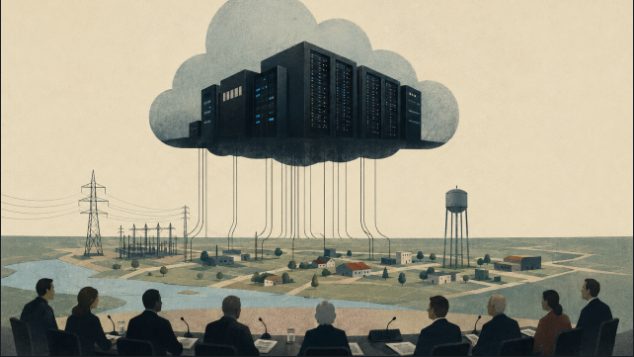
The Cloud Has a Zoning Board
We have spent two decades pretending the cloud is weightless. The metaphor did its job too well: it made the digital world feel invisible, frictionless, and detached from the physical one.
Then the cloud arrived in East Fishkill, New York, as a proposed 1-gigawatt data center.
The town was not being asked to approve an app; it was being asked to host a piece of the AI industrial system: land, power, cooling, transmission, backup systems, and all the local politics that come with them. The response was not a celebration of technological progress, but a unanimous three-year moratorium.
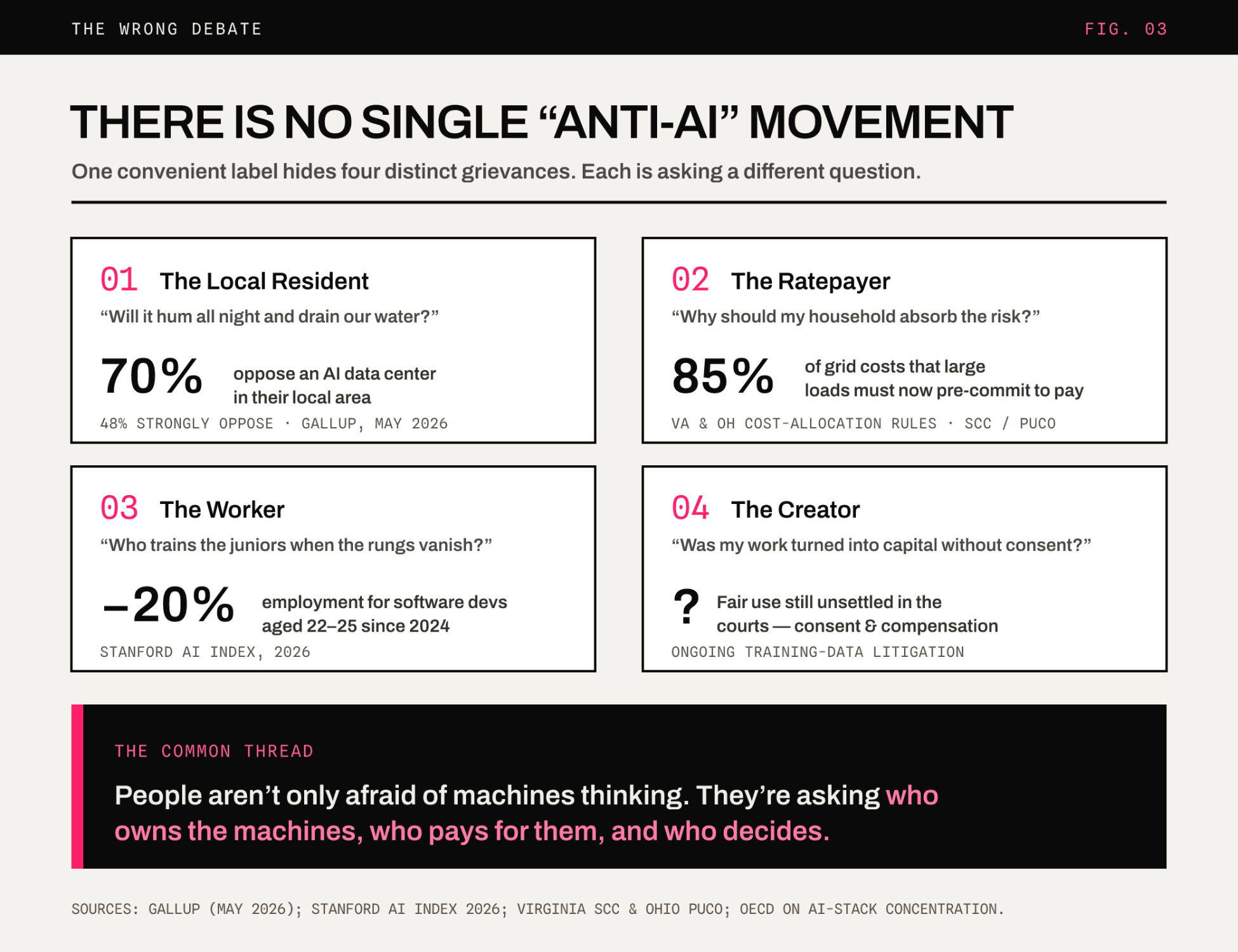
East Fishkill is not alone. In Nashville, the mayor explored eminent domain to stop a data center from being built near the local zoo. Tucson and Pima County have seen fights over water, disclosure, and desert growth. According to Gallup polling, seven in ten Americans now oppose the construction of an AI data center in their local area.
This is the contradiction at the heart of the AI era: AI use is spreading quickly through work, school, search, software, and daily life, but many of the same people who benefit from AI-enabled tools are far less willing to host the physical infrastructure required to make them run.
AI stopped being just software when it started asking cities for water and utilities for power. The cloud, much to the public's surprise, has a zoning board now...
That is why the AI backlash looks irrational only when the technology is treated as software. Once it is treated as a physical buildout, the backlash becomes more legible. The better question is not whether AI should happen. It is who benefits, who pays, and who gets to decide before the costs arrive.
The Wrong Debate
Because we lack a good vocabulary for this shift, the public debate has collapsed into a useless binary:
Are you for or against AI?
But there is no single "anti-AI" movement. Treating the current backlash as one coherent, anti-technology ideology produces terrible analysis and even worse policy. What we actually have is a coalition of distinct, overlapping grievances traveling under one convenient label.
The local resident at a zoning meeting is not usually debating machine consciousness. They want to know whether the project will hum all night, draw from a stressed water system, or leave their town with more substations than jobs. The ratepayer has a different question: if a utility builds new transmission for a trillion-dollar company, why should ordinary households absorb the risk if the project underdelivers?
The worker is watching the compression of junior hiring pipelines, wondering who pays when entry-level tasks disappear. Meanwhile, the writer, artist, or publisher is fighting still another battle, over whether human culture can be converted into machine capital without consent or compensation.
The backlash is intensified by a trust deficit. Many communities do not believe developers, utilities, or state officials will tell them the full cost before the project is effectively decided. And once residents believe the process is rigged, every technical claim about water, noise, jobs, or grid upgrades starts to sound like marketing...
Lumping all of these groups together as "anti-AI" is a category error. People are not only afraid of machines thinking.
They are afraid of who will own the machines, who will pay for them, and who will be made obsolete by them.
AI Has Become Infrastructure
Most people still imagine AI as a chatbot or an image generator for taking care of that pesky email or helping you with your latest IG post. But the real buildout is industrial: data centers, GPUs, power plants, substations, transmission lines, cooling systems, and fiber networks (Ya it's alot...). AI has intensified data-center growth because accelerated servers pack more power and heat into smaller physical footprints, increasing demand for specialized cooling, power distribution, and grid planning.
Not every data center is an AI facility, and not every megawatt of data-center growth comes from AI. Cloud migration, conventional hyperscale expansion, and ordinary digital demand still matter. But AI has become one of the main accelerants of the largest new load requests. Even when a facility is not exclusively for AI, AI-driven load growth has changed the scale of the buildout. Which is why ordinary data-center politics now increasingly functions as AI politics.
The numbers are no longer marginal. The Department of Energy’s Lawrence Berkeley National Laboratory estimates that U.S. data-center electricity use reached 176 TWh in 2023, accounting for 4.4 percent of total U.S. electricity consumption. By 2028, under certain modeling scenarios, data centers could account for between 6.7 and 12 percent of U.S. electricity use.
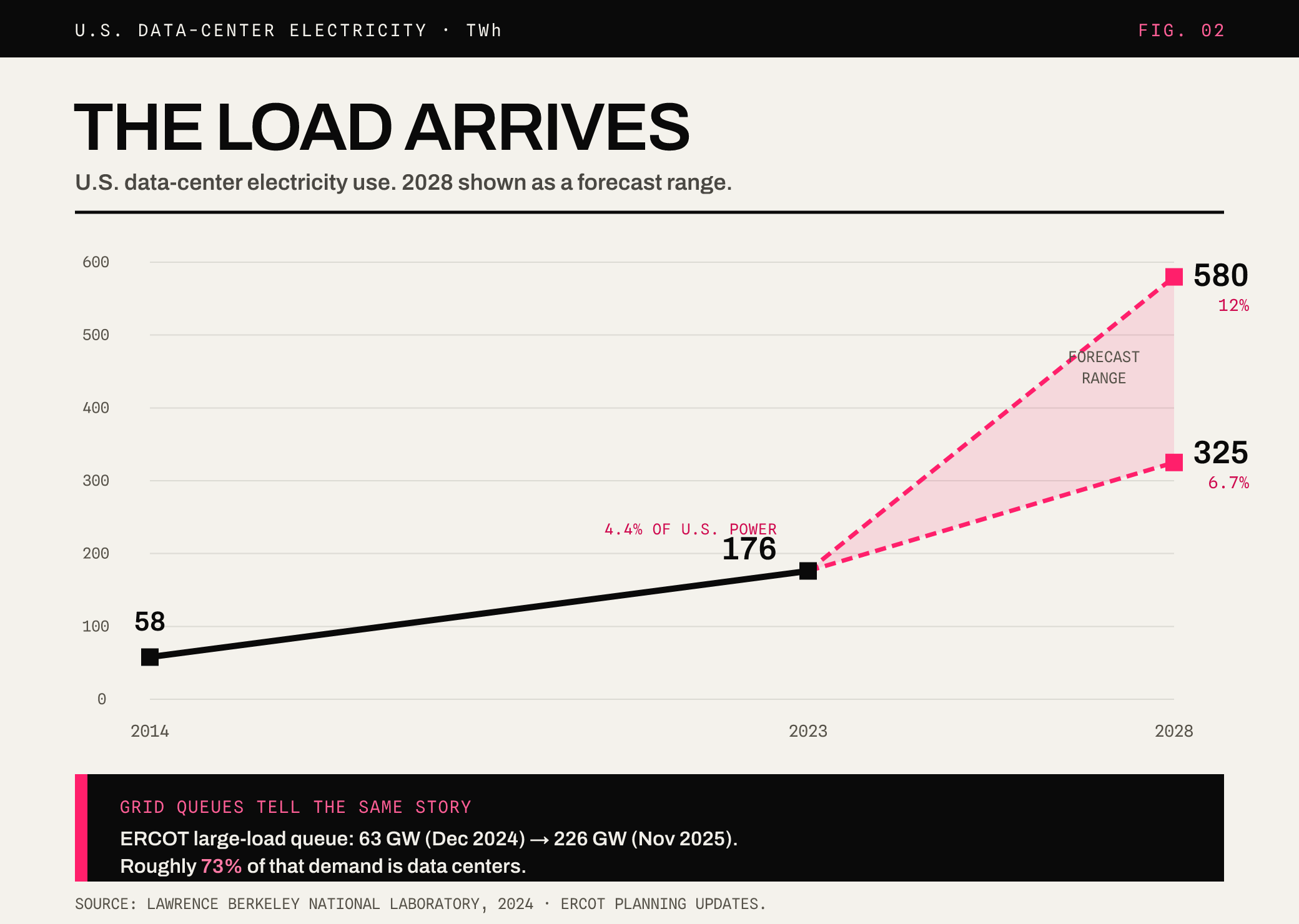
That demand is now large enough to reshape utility planning. Grid operators and regulators in PJM, ERCOT, SPP, Ohio, Texas, and Virginia are rewriting large-load planning, interconnection, and tariff rules because the scale and speed of these requests no longer fit the old process.
Once a technology becomes an industrial system, the politics stop being abstract.
The Backlash Has a Point
The techno-optimist reflex is to dismiss public anxiety as a failure of imagination.
But if you steelman the critics' arguments, you quickly realize they are pointing at real institutional failures.
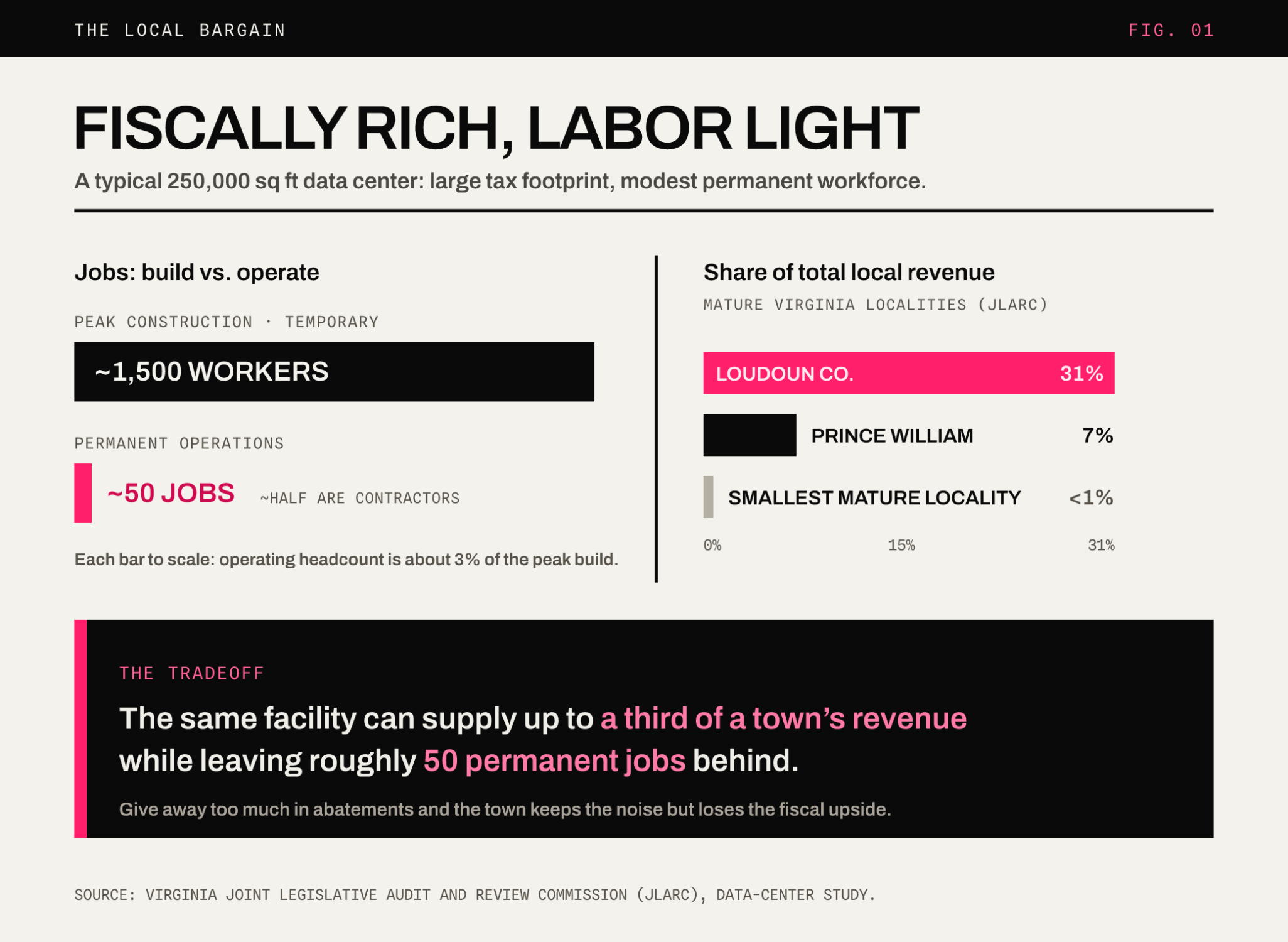
Consider the local economic bargain. Data centers can be highly fiscally valuable to a municipality, but they are also unusually labor-light relative to their capital footprint. A report by Virginia's Joint Legislative Audit and Review Commission (JLARC) quantified the tradeoff. Across five mature Virginia localities, data-center revenue ranged from less than 1 percent to as much as 31 percent of total local revenue. Yet a typical 250,000-square-foot facility might employ only about 50 full-time workers after construction, even though the build phase can require roughly 1,500 tradespeople.
If a town gives away too much in tax abatements, it may surrender the very fiscal upside that makes the project attractive, while receiving a facility whose permanent workforce is modest compared with its capital footprint.
The same rationality applies to labor concerns. Early evidence points less to mass unemployment than to pressure on the first rungs of white-collar careers. Stanford-linked research has found a sharp decline in employment among young workers in highly exposed occupations, including software development, while other labor research suggests the effects are showing up unevenly in hiring pipelines and junior roles. That does not prove AI is the sole cause, but it is exactly the kind of early labor-market signal policymakers should take seriously. The immediate risk is not that humans become obsolete, but that the entry-level tasks we traditionally used to train junior workers are automated away.
The same is true of creators and publishers. Their objection is not merely that machines can imitate style. It is that model developers may have converted decades of human cultural production into commercial systems without consent, compensation, or bargaining leverage. The courts have not settled the issue, and fair-use arguments remain serious. But the backlash is not just aesthetic discomfort. It is a dispute over who gets to turn culture into capital.
These concerns deserve governance. They do not, by themselves, justify treating the entire buildout as a public nuisance.
But Panic Is Not Policy
The reason is that compute is becoming productive, systemic capital. It supports scientific research, drug discovery, software development, logistics, defense, manufacturing, and thousands of downstream tools. These will not look like AI products at all. Like electricity or broadband, its value will often appear far from the facility that enables it.
Local costs arrive visibly. Benefits arrive diffusely. The town sees the substation, the country gets the productivity upside, the company captures the direct revenue, the utility manages the load, and the resident hears the hum. That is what makes the politics so hard: the burdens are local and immediate, while the benefits are widely dispersed.
However, the fact that AI creates real externalities does not mean the answer is broad resistance. Panic is a terrible policy tool.
Take the issue of water. The national rhetoric suggests that AI is draining America dry. The reality is highly situational. JLARC found that data-center water use accounted for less than 0.5 percent of total statewide withdrawals in Virginia. Yet, in specific local utilities, data centers accounted for up to 21 percent of water use. The water story is not national apocalypse or corporate innocence. It is local siting, cooling design, water source, disclosure, and scarcity.
The claim that "data centers are raising utility bills" requires the same precision. They can raise bills when utilities socialize the costs of massive grid upgrades across all households. But the target is not electricity use itself; it is weak cost allocation. A data center that pays its true marginal grid costs is different from one whose risks are quietly spread across ordinary ratepayers.
The Real Question Is Who Pays, and Who Decides
If there is a single question that brings the entire AI backlash into focus, it is this: Who captures the upside, who absorbs the costs, and who gets a say before the bill comes due?
This is the essence of the current friction. The mechanics of ratepayer protection are not complicated, even if utility jargon tries bravely to make them so. If a utility builds a substation, transmission line, or generation resource for a 500-megawatt customer that later delays, downsizes, or walks away, someone still has to pay for the asset. Without strong contracts, that cost can end up spread across ordinary ratepayers.
Minimum-demand charges, collateral requirements, and take-or-pay contracts are ways of making the large customer commit financially before the public is asked to absorb the risk. The central question is not whether data centers use power. It is whether the companies creating the load pay the true cost of serving it.
But cost allocation is only half the problem. The other half is legitimacy. The fight is not only over costs; it is over whether communities believe they were told the truth before the decision was effectively made. The decision points matter: zoning boards, utility commissions, state incentive packages, water authorities, and community-benefit negotiations are now part of AI governance whether the tech industry likes it or not.
The same question appears everywhere else. On water, who gets access to scarce supply, and under what disclosure rules? On taxes, does the host community receive durable revenue after incentives, or does it give away the very upside that made the project attractive? On labor, who pays when entry-level tasks disappear before new career ladders form? On copyright, who gets compensated when human culture becomes machine capital? On competition, who benefits if the same firms control the chips, cloud, models, and distribution?
Once the debate is translated this way, the policy task becomes clearer. Build where the value is real. But make the beneficiaries internalize the costs, disclose the tradeoffs, and negotiate with the communities asked to host the burden.
A Steering System... Not a Brake
Most major general-purpose technologies create backlash. Sometimes the backlash exaggerates the danger. But the durable backlash often points to something real:
an institutional failure to allocate costs fairly.
The job of government at every level is not to act as a brake pedal on AI. Freezing development is not a serious long-term strategy in a global technology race. Instead, policy must act as a steering system. We must build the compute, the grid, the water facilities, and the transmission capacity that productive AI requires. But we must simultaneously price the externalities, force transparency, protect ratepayers, support workers, and preserve competition.
The cloud was never weightless. We merely outsourced the weight until it showed up in someone else’s zoning meeting. Now that the digital world has a physical footprint, the old debate over whether the technology is good or bad is too small for the problem in front of us. Infrastructure always produces politics. The real question is whether we can build the institutions required to allocate the costs, share the gains, and govern the risks, or whether we will keep arguing about whether the cloud should exist while cities fight over the substation.