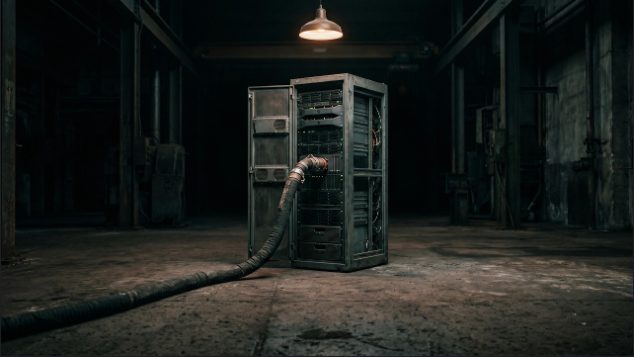
The Cloud Has an Air Hose: AI, Hormuz, and the End of Weightless Software
If you were a commercial deep-sea diver in the 1920s, your working life depended on the "Standard Diving Dress." A heavy canvas suit and a spun-copper helmet. When you descended to the seafloor, you felt remarkably light. But that feeling of weightlessness was a profound cognitive illusion.
You were not free. Attached to your helmet was a thick rubber air hose stretching back to the surface. Above you sat a massive support ship with roaring compressors and a crew managing the winches. Meaning your movements below were entirely purchased by centralized infrastructure above. If a piece of debris pinched your line, your operation ended instantly.
When it comes to today.... the interface hides the machinery. We make a similar mistake with modern artificial intelligence. We tend to categorize it as weightless software, even though the system behind it is anything but weightless. AI is not running out of intelligence. It is running into the physical cost of delivering intelligence.
AI Is Infrastructure Now
This is not an argument that AI demand is fake, or that cloud AI is going to disappear. Rather, it is a recognition that the market is finally discovering the cost of delivering intelligence at industrial scale.
The numbers we are dealing with are no longer software numbers; they are heavy infrastructure numbers. Global data centers consumed about 415 TWh in 2024 and are projected to reach around 945 TWh by 2030. To meet that demand, hyperscalers are spending hundreds of billions annually on AI infrastructure and data centers.
We have essentially scaled digital intelligence by building one of the most energy-dense centralized systems ever attempted. It needs substations, cooling loops, diesel backup, power contracts, and crews who can actually build. The umbilical cord keeping the AI ecosystem alive is not a single line; it is a bundled system of hoses; a financing hose, an electrical hose, and a fuel hose.
None of these lines exist in a vacuum. They snake across the global economy, dragging through physical realities and supply chain chokepoints. Which brings us to the most vulnerable inch of the global energy hose: the Strait of Hormuz.
Hormuz serves as a primary valve for the global energy system, handling the export of nearly 20 million barrels of oil per day in 2025. Analysts estimate a prolonged closure could cause a 13 to 14 million barrels per day supply loss.
The catch is that the physical market cannot smoothly route around a disruption of that magnitude. When geopolitical tensions spiked in March 2026, global observed oil inventories fell by 85 million barrels. In the commodities market, a drawdown like that means the system is physically tight. Financial markets can reprice risk in a millisecond, but physical tankers cannot be teleported.
Hormuz is a stress test. It shows how little slack exists beneath AI’s interface.
Oil Doesn’t Power the Model. It Powers the World Around the Model.
The obvious pushback here is that data centers run on electricity, not crude oil.
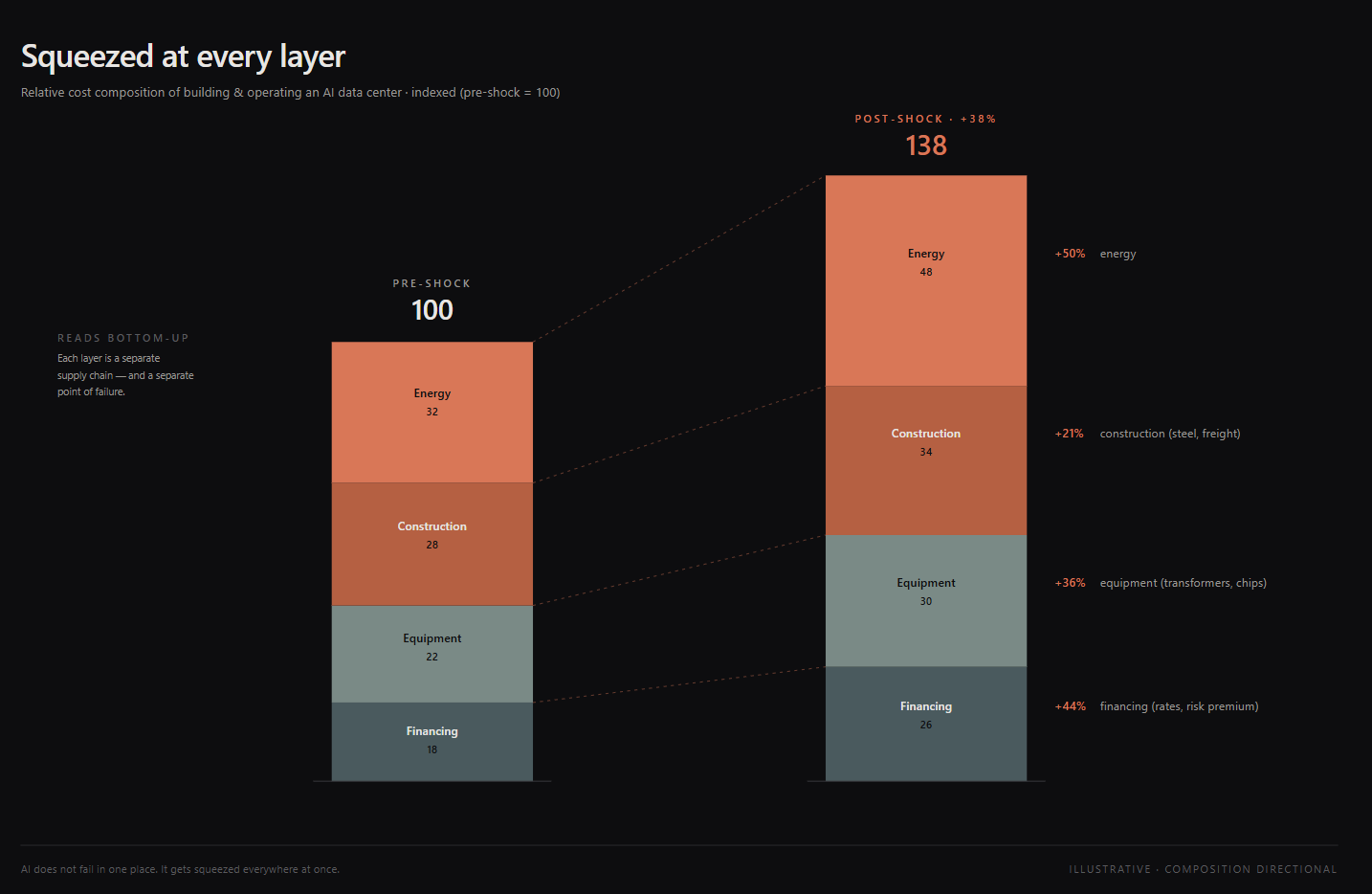
But that misses the way complex industrial systems actually fail. Oil doesn't power the model. It powers the world around the model. It acts as the mobility layer of the physical economy, moving the transformers, chips, cooling equipment, construction crews, and freight that allow the electrical grid to expand. A crude shock does not have to plug directly into the server rack to reach AI. It only has to raise the cost of building, financing, and supplying the system around it.
The connection is indirect, but that is exactly how fragile systems tend to break. Not from a direct hit to the core algorithm, but from a failure in the quiet, second-order dependencies that hold the whole thing together.
Pinching the Capital Hose
The problem with an energy shock is that it rarely stays in the energy market.
When energy inflation becomes broad enough, central banks face pressure to keep policy tighter for longer. This pinches the financing hose. The AI sector's valuations rely heavily on the assumption that capital will remain cheap enough to fund years of continuous expansion.
When interest rates rise, AI ceases to be a capability race and abruptly becomes a capital efficiency game. The timeline for a new data center buildout is scrutinized. Payback periods that looked acceptable in a zero-interest-rate environment become fatal. The tolerance for idle compute capacity drops to zero.
At the same time, the electrical hose begins to choke. In the U.S. alone, there was an immense 2.29 TW backlog of generation and storage actively seeking interconnection at the end of 2024. With the grid struggling to expand quickly enough, natural gas has become a critical, flexible fuel for data centers.
If Hormuz closes, nearly one-fifth of global LNG trade becomes stranded. This tightens the global gas balance, forcing policymakers to confront a brutal tradeoff: the same natural gas needed to stabilize the grid is now also needed to backstop AI growth, industrial demand, and international energy security.
We can already see this pressure building even without a full crisis. The EIA notes that under a high-demand data-center scenario, Texas ERCOT’s 2027 wholesale power price would be $37/MWh higher than its February forecast, representing a 79% increase. AI load growth alone is already enough to stress regional power markets, meaning a global gas shock would simply reveal how little slack was left.
The Era of Allocated Intelligence
What actually breaks first in this scenario? It isn’t the foundational model. Fragile systems fail at the edges. The failure modes look like canceled substation builds and multi-year project delays because transformers are backordered. They look like power rationing imposed by regional utilities. They look like severe margin compression, where the physical cost of liquid cooling outpaces the revenue of the API call.
How did the diving industry eventually solve the inherent vulnerability of the surface-supplied diver?
They didn't build bigger ships. Instead, when Jacques Cousteau co-invented the Aqua-Lung, they created another architecture for the dives that didn't need the ship. By compressing air into a cylinder carried on the diver's back, they traded a fragile central engine for distributed, autonomous capability.
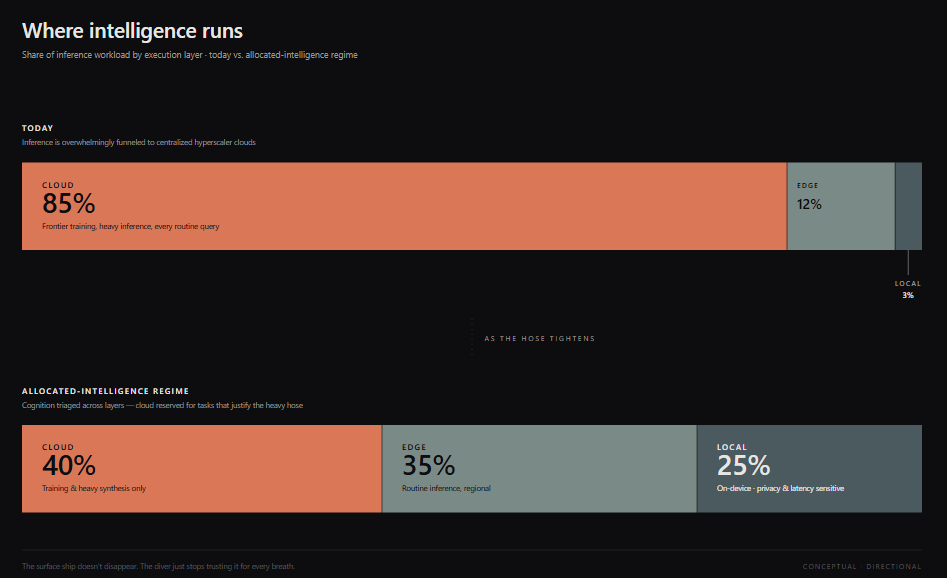
The artificial intelligence industry is rushing toward its own Aqua-Lung moment, but not because the cloud will disappear. The surface ship remains essential for massive synthesis and frontier training.
But AI is no longer a software industry. It is an infrastructure regime. And infrastructure regimes do not care about your demo. They care about fuel, financing, logistics, latency, and failure tolerance.
The uncomfortable reality is that intelligence will no longer be treated as an infinite resource to be summoned at will. It will become an allocated resource. It will be rationed by capital costs, priced dynamically by the grid, and politically constrained by the nation-state. The winning systems will not simply be the ones with the most parameters; they will be the ones that know exactly how to triage cognition. Deciding which tasks justify the expense of the heavy hose, and which must carry their own air.
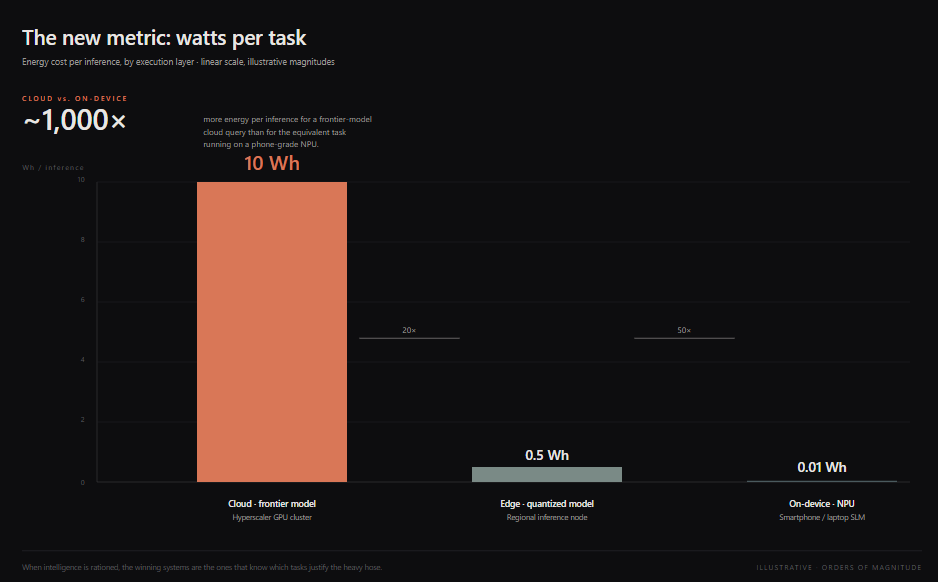
It succeeds only when it adopts its fundamental reality: availability is always governed by scarcity.